
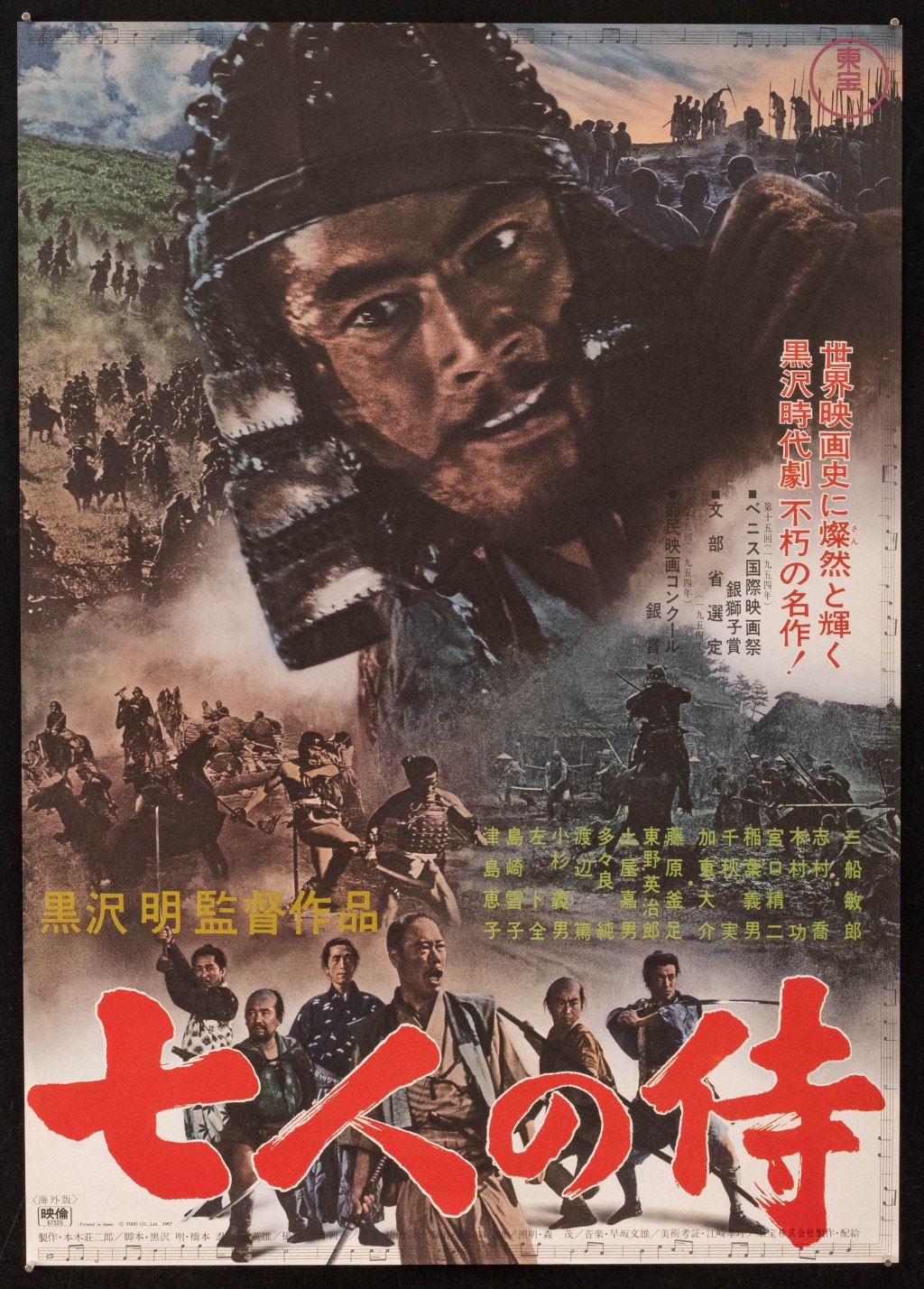
Director Akira Kurosawa’s towering landmark, Seven Samurai, is a universally praised, timeless jewel of world cinema, but it also represents a personal landmark on my journey into cinephilia. This was decades ago (*shudder*) in the halcyon days of Netflix rentals, when a red envelope containing Seven Samurai arrived on my doorstep alongside Jean Renoir’s The Grand Illusion and Carl Theodor Dreyer’s The Passion of Joan of Arc. A world cinema starter pack, if you will. I fell in love with them all, but didn’t really know why at the time.
Now those joyous red envelopes are merely a nostalgic figment of my fading memory, but thankfully physical media is not. (This film, alone, had two different 4K releases within the last year – one in the US from Criterion Collection, and one in the UK from BFI.) A few days ago I had the pleasure of viewing Seven Samurai with a fresh new transfer, but also with an older, more seasoned perspective. As such, I’ve come back to talk a little bit about what makes the film so great to me.
Of course, it tells a timeless story – a poor 16th century farming village has been ransacked into extreme poverty by a group of bandits after years of constant pillaging. Staring starvation in the eye, the desperate villagers hire a team of samurai to protect them from the next attack rather than give up and lose everything. If that sounds familiar it’s because Seven Samurai is often credited as the first team-up action movie, influencing films from the westernized American remake, The Magnificent Seven, to the Fast and Furious franchise. But I’m setting the story aside today because I want to highlight some of the technical aspects that elevated the film’s basic “good guys-vs-bad guys” story into a cinematic monolith that eternally resides in the top 10 of most reputable adjudicator’s list.
That separation is part of the duality I feel as both a writer and a film fan. The film fan in me could talk about story and character for hours, but these days I find the writer side of me obsessing over the influence of form on the narrative and the ways in which filmmakers construct visuals and arrange the accompanying pieces. Kurosawa is a treasure for such endeavors. Like many great filmmakers, he was a demanding director who insisted on total respect of his vision. Not to be difficult, necessarily, but because he understood that precise, carefully constructed visuals would complement and deepen the concepts he was exploring in the film.
There’s a big difference between directors who set the camera down to record what’s written in the script and technicians such as Kurosawa who configure the tiniest details into visual expressions of intangible concepts. Even seemingly insignificant details, such as the subtle ways objects and actors are arranged in the frame, make a great deal of importance to the character, the scene, and even the whole story.
Let’s take a look at few stills from the movie to illustrate what I’m talking about.

This is a very minimal, basic set-up taken from a scene about 2/3 through the film. Notice the use of deep focus photography – we can see fine details in both the foreground and the background. Without an obvious focal point, the staging of the scene becomes our guide.


There are two points of interest here – 1) a sword in the foreground, the symbol of a fallen warrior, and 2) his samurai mates standing behind the grave. From left to right, the staging directs our attention – Gorobei (Yoshio Inaba) looks to his right, guiding our eyes toward their leader, Kambei (Takashi Shimura), who directs his gaze (and ours) downward toward the ceremonial gravesite. Notice how both the men and the sword are bisected at the mid-body, yet the position of the sword in the frame makes it loom over the two men. Ostensibly, the purpose of the scene is to show the grief-stricken warriors discussing how to forge ahead with only six men remaining, but Kurosawa’s masterful staging gives the sword a stronger presence in the frame, ensuring the symbolism is at the forefront of the visual. There is still a battle to fight, but the loss of their friend carries the heaviest weight in the scene.
You can also read the prominent position of the sword to be one of Kurosawa’s subtle subversions of the bushido, or the code of principles that dictates a samurai’s moral and ethical behavior. Among several tenets, the code stresses absolute loyalty to a master or charge above all. So here, Kurosawa challenges their strict obligation to duty. He has the men linger and mourn by the grave of their fallen friend, discussing how important his spirit and character was to the team, while his sword, an image of both protection and destruction, holds a metaphorically significant position in the frame, and is literally plunged into his supposed resting place. To me, the image isn’t one of obligatory reverence. These men do not seem consoled at the thought of their friend dying “honorably” in battle, which represents a stark departure from the samurai’s traditionally cold adherence to responsibility.
The next scene I want to take a look at features the rebellious personification of this concept:

Here we have a much busier setup featuring nearly two dozen actors in focus. This image is taken from a scene involving a hostage situation in a neighboring village very early in the film, before we’ve met many characters outside of the besieged townsfolk looking to hire their samurai protectors. Again, both the foreground and the background are in full focus, but with an intriguing amount of attention paid to the mysterious onlooker (Toshiro Mifune) seated in the foreground watching the rescue attempt just off-camera.

At this point Mifune’s character is an unknown entity. Notice how the matching eyelines direct our attention to three different points around the frame: 1) the hostage situation off-screen to the right, 2) the parents of the kidnapped child standing in the midground, and 3) Mifune’s enigmatic spectator occupying a strong, central space in the frame. The villagers behind him are miniscule by comparison. It makes us ask, “Who is this man taking center stage while an active hostage situation unfolds to the right of the camera?” We’ll find out soon enough, but for now this carefully orchestrated arrangement not only keeps the focus on the action, it also introduces a larger-than-life character in both the literal and figurative sense.
Contrast that against this image from a short time later in the film:

This scene finds Mifune’s drunken wannabe, Kikuchiyo, falsely proclaiming samurai ancestry in order to prove he’s worthy to join the team of warriors. He presents a family scroll, which reveals the embarrassing truth: not only is Kikuchiyo not of samurai heritage, but he’s also illiterate and has unwittingly taken a female’s name. Once again, the composition provides a visual companion to the conflict that’s playing out in the narrative.

Like the prior stills, both planes are in focus. Notice the difference in Kikuchiyo’s stature compared to the previous scene. He’s slumped over on the far right side, humiliated, and almost in shadow; no longer a character of intrigue, now a fraud unmasked – a far cry from his powerful position in the village square.
Kikuchiyo’s ignobility is opposed in the foreground by the man on the far left, Kyuzo (Seiji Miyaguchi), while the rest of the team occupies the lighted space in the background. Notice how Kyuzo, representing the stoic, ideal depiction of a samurai, is seated in an adversarial position across from the untamed, lower class Kikuchiyo. You can see that Kyuzo is also nearly in shadow, but observe how high and upright he’s seated in the frame, and how tightly he clutches his weapon – a visual representation of his elevated class and reserved but deadly character.
Contrast his presence against Kikuchiyo’s dejected posture and unmanned sword in the middle of the table, which is both emblematic of his recklessness and also a physical and symbolic representation of their class division. The team will eventually relent and accept him, again breaking with bushido norms, but notice here how Kurosawa reflects Kikuchiyo’s diminished position by having all the men appear to look down on him at roughly the same angle. As we find out later, he proves himself to be a worthy and honorable warrior, but here, in his most humbling moment, Kurosawa uses the staging to literally and metaphorically visualize Kikuchiyo’s minimized social stature in the eyes of this team of noble samurai.
Like you needed to hear this from me, but clearly Kurosawa was a master of his craft. There are dozens more of these examples throughout the film (see a few more below) and I could go on for hours, but I think you get the idea. Seven Samurai is a feast for the eyes, the mind, and the soul, and still stands as one of the crowning achievements in all of film history.
‘Til next time, thanks for reading!



 Partially Obstructed Cinema
Leave a comment