

It should come as no surprise that body horror makes me uncomfortable – that’s the intention. It is a distinctly grotesque subgenre filled with all manner of gross effects. It’s also a very fertile metaphorical pasture.
Of course much of horror can make us feel uneased, but there is something uniquely unsettling about our physical bodies being warped, contaminated, and/or transformed into something unnatural. It makes us squirm and check our appendages for unusual growths, much the same way we inspect the back seat for masked killers after watching a slasher bloodbath. Those with a keen eye for stimulating that gut response – the inescapable urge to clench up and dig your fingernails into your own skin – make an artform out of folding the material into richer themes.
One such soul, famed Canadian filmmaker and provocateur David Cronenberg, has given us a rich tapestry of deformed bodies, leaking fluids, and sinewy discharges in his 50+ years in the director’s chair. He’s an auteur beloved by horror fans for making his audience retch, while also critically renowned for making them think.
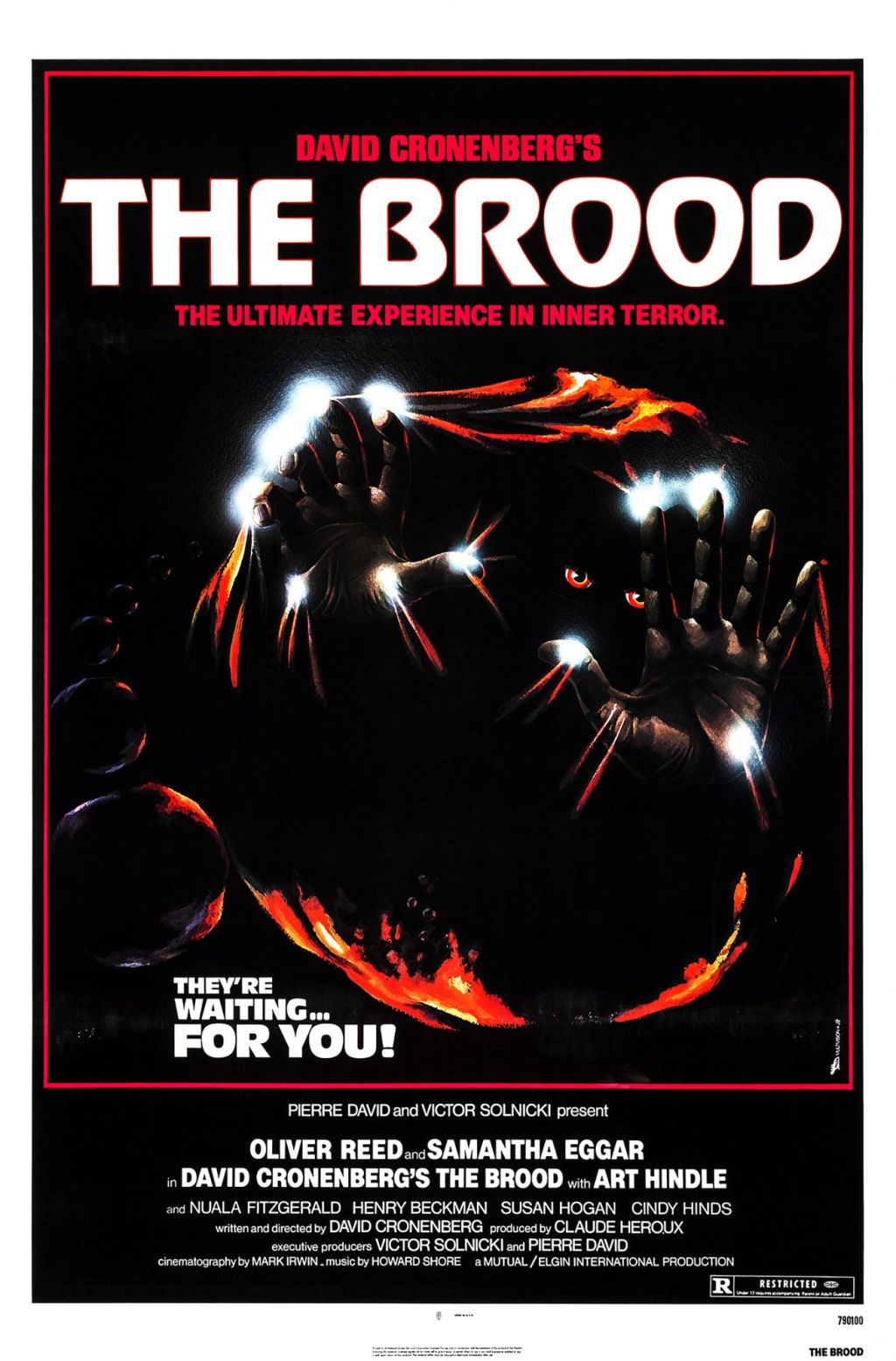
One of his earliest feature films, 1979’s THE BROOD, about a family wrapped in dangerous conflict, slow plays the shock effect and instead interweaves psychological and body horror components, with some slasher elements sprinkled in. As opposed to other Cronenberg films such as SCANNERS, where the “highlight” is right up front, this film instead builds a mystery and sense of dread, opting to save the big moment until the end for greater effect.
And what an effect.
Knowing when to stage the show-stopping moment is part of Cronenberg’s genius. Opening SCANNERS with the film’s biggest effect is a gutsy move (pun intended), but it also establishes the world and level of danger in that film. THE BROOD, on the other hand, is committed to unraveling a puzzle, with the climactic unveiling bearing the weight of everything that came before it on its shoulders.
Thematically, the film explores the cyclical nature and psychological ramifications of family trauma by channeling the domestic dissention into stomach-churning body horror, pushing the envelope of what motherhood, and parenting, really means.
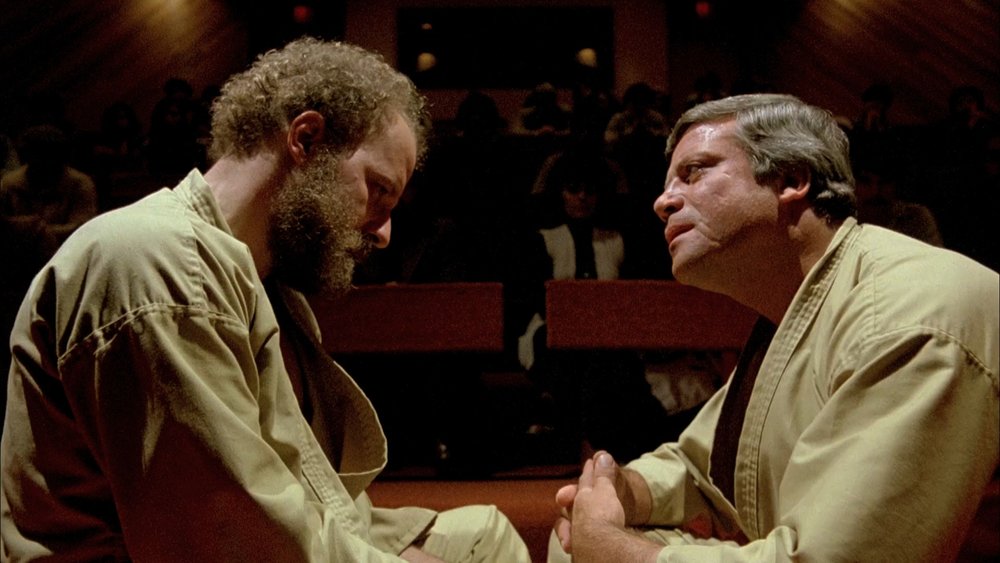
Set in a bleak winter landscape, the film opens with a therapeutic demonstration – Dr. Hal Raglan (Oliver Reed) sits centerstage in a darkened performance theater with one of his patients, Michael (Gary McKeehan), seated across from him. Frank Carveth (Art Hindle) grabs a chair in the audience with a cynical interest in the exhibition. We’ll find out shortly that Frank’s wife, Nola (Samantha Eggers), is also a patient of Dr. Raglan’s.
Anyone familiar with Cronenberg knows the concept of corrupting our bodies is a common one for him, whether it’s sex parasites (SHIVERS), a television broadcast (VIDEODROME), or scientific experiments (THE FLY). The unnatural desire to control elements beyond our grasp is a pervasive theme in these films, and body horror in general. In each film other humans are directly, or indirectly, responsible for the loss of life. Humans hungry for power, humans wanting to bend nature’s laws, humans believing the world needs correcting.
THE BROOD, however, offers a more homegrown nightmare (more puns!) with loss of life stemming from indifference and unchecked abuse by those closest to us. The central idea goes right to the heart of many of society’s ailments – repressed trauma. And specifically in this case, the emotional rot and decay caused by family trauma.
At least, that’s what Dr. Raglan has been working on with Michael, Nola, and the others who live in isolation at his “Psychoplasmics” institute. The theory involves a sort of role playing exercise designed to extract an emotional response in order to bring these issues to the surface. But in practice it extracts so much more.
In the opening demonstration, Dr. Raglan plays the overbearing “father” to his meek, belittled patient/”son”, Michael. The treatment involves several waves of severe verbal abuse, wherein Dr. Raglan drags Michael through his trauma while begging the subject to let his anger towards his father out. The exchange culminates with Michael removing his shirt to show an outbreak of welts on his body – the physical manifestation of Michael’s repressed emotions.
The performance elicits little more than a scoff from Frank, but we quickly realize the rest of the audience does not share his skepticism. Which is possibly a subtle nod from Cronenberg about the social climate at the time. The exact methods Dr. Raglan uses for his psychoplasmic therapy are not advertised to the public, and the only way to know is to become a patient or attend one of the demonstrations.

So, coupled with being a product of the late ’70s, we can assume we’re dealing with a disillusioned public who blindly welcomes Dr. Raglan’s radical therapy and secretive practices with open arms. Even today it’s not uncommon for new mental health treatments to catch the public’s attention and ride the media blitz (podcasts, book deals, tv appearances, etc), sending the “doctors” to fame a fortune – at least until the impossible promise isn’t kept and something new comes along.
Unfortunately, we don’t get the answer to the million dollar question – why do we always fall for it?
Trapped in the middle of all of this is Frank and Nola’s young daughter, Candice (Cindy Hinds), who’s in Frank’s custody while mom is under the care of Dr. Raglan. Much to Frank’s chagrin, Nola is legally permitted to have weekend visits with her daughter at the institute. But the situation comes to a boil when Frank brings Candice home and discovers fresh bruises, bite marks, and cuts on her back resulting from her last stay with mom.
Now the mystery Frank has to solve is – did Nola hurt Candice, or was it something else? And what role, if any, does Dr. Raglan’s secretive therapy play in it?
Apart from DEAD RINGERS, and later A HISTORY OF VIOLENCE, I can’t think of too many Cronenberg movies that focus on the family unit. Here it’s front and center, and the drama includes more than just the nuclear trio.
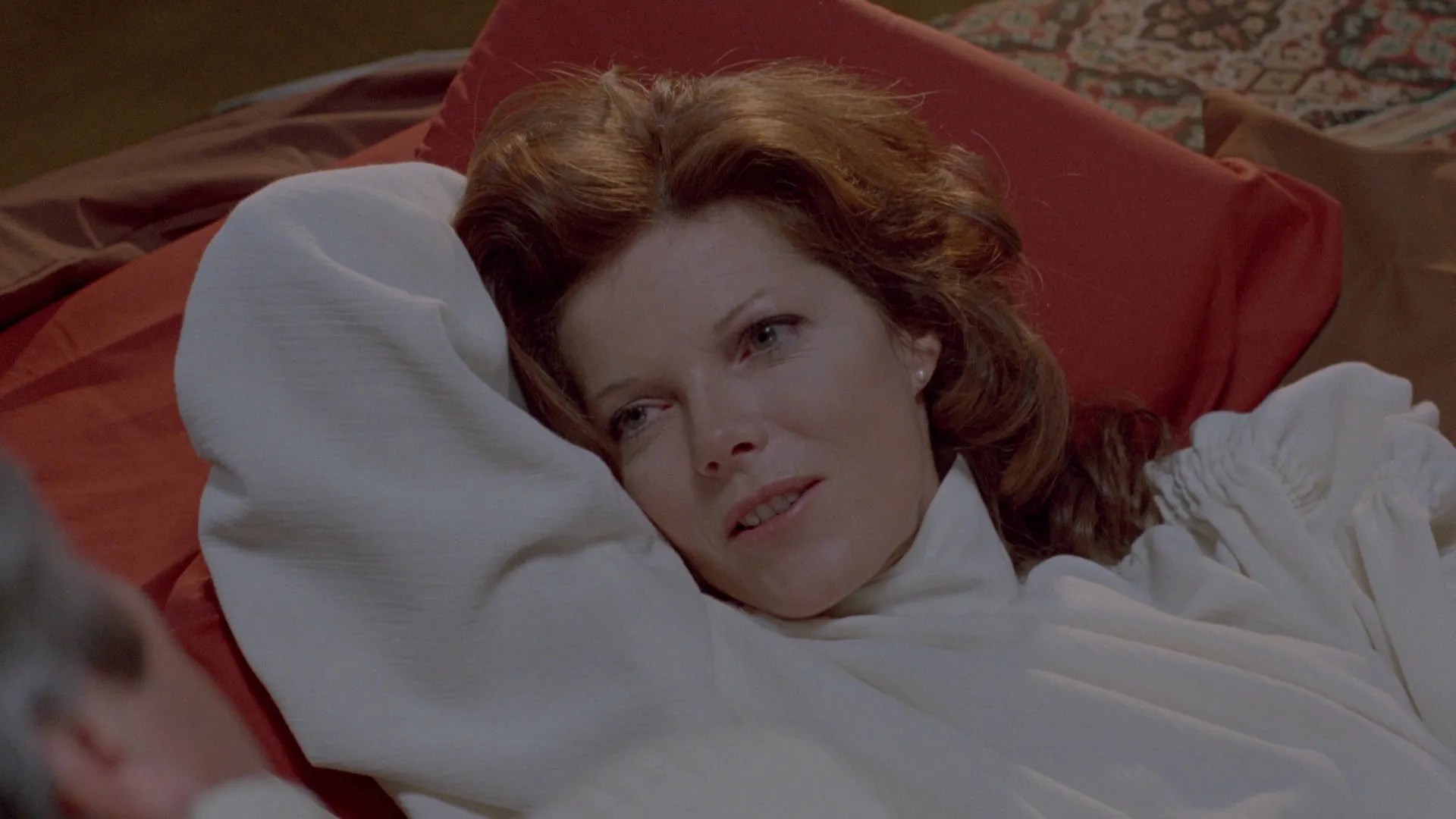
Nola’s first session with Dr. Raglan is a role play wherein she confronts her “mother” about the severe physical and mental anguish she suffered at the hands of her abusive, alcoholic mother. Then later in the film she confesses her disappointment and feelings of betrayal towards her alcoholic father, who turned a blind eye to her mother’s behavior. This toxic, depressive home is the gooey black center of her trauma and the resulting pain and sorrow. Again, Dr. Raglan pleads with Nola to “show” her anger.
As a therapeutic experiment, it’s remarkably successful. It’s a coercion tactic, but one that produces physical results more often than psychological ones.
About halfway through the movie, Frank looks for help from some former patients of Dr. Raglan’s and he forms a pseudo-partnership with Jan (Robert A. Silverman), a quirky fellow with his own ax to grind against Dr. Raglan. Injecting a welcome burst of personality, we meet the eccentric Jan, who suffers from psychoplasmic-induced lymphoma after being under the care of the famed doctor. The reveal is punctuated with a gnarly practical effect growing on his throat. The grim result of “showing” his emotions.
Though his films might be better categorized as unsettling rather than classically scary, I find THE BROOD to be more terrifying than some of the other Cronenberg films mentioned above. Instead of chills by way of a nefarious plot schemed up with fantasies/delusions of grandeur, we see the visceral consumption and corrosion coming from within ourselves and from those closest to us. It’s sad, tragic, and disgusting.
If there’s any film in his oeuvre that compares to it in emotion, I’d say it’s THE FLY. Both films present flawed human beings unable to control the self-destruction as they wind up destroying themselves and the ones they love.
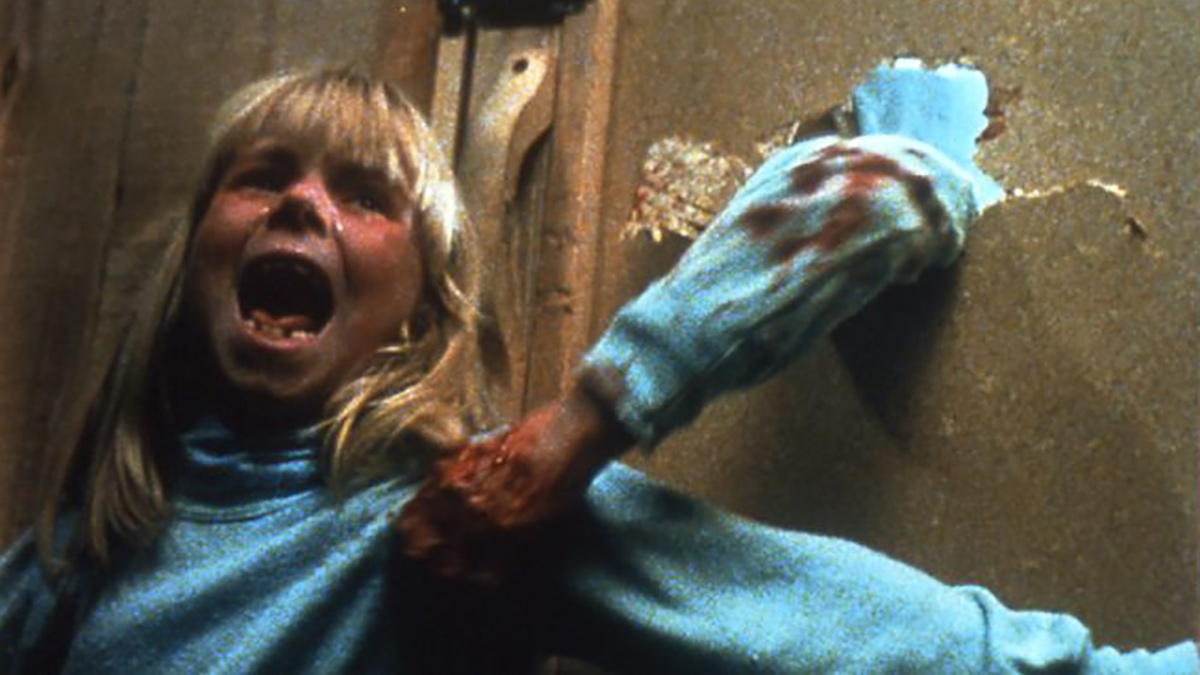
This is perfectly displayed by poor Candice, who is under constant duress during the film. The torment offers up some standard horror scares in the form of murderous dwarves who seem to have an agenda against anyone close to Nola, especially Candice. Aside from the obvious tension boost from a child in danger situation, this is also Cronenberg visualizing the constant fear, pain, and torment children are subjected to when mom and dad are in a bitter dispute.
At first I didn’t think the stalk-and-slash element narratively meshed well with the psychological portions of the film, but the dwarves do play a central role in the shocking climax, as their nature and origin is revealed. They can be seen as signifiers for the physical and psychological attacks that parents unknowingly inflict upon their children – the kinds that scar families across generations and cause blood relationships to die out completely.
While David Cronenberg’s THE BROOD is light on narrative action, a la some of his more renowned works, the brief runtime is packed with fascinating ideas and complementary story beats that keep the mystery compelling, before finally leading us into the truly shocking conclusion. No one does it better than David Cronenberg.



 Partially Obstructed Cinema
Leave a comment